Johannes Brahms
Johannes Brahms - German composer
Person from Germany
Genres: Classical, romantic, german, composers, instrumental
Similar artists via Last.fm
 Robert Schumann
About Johannes Brahms
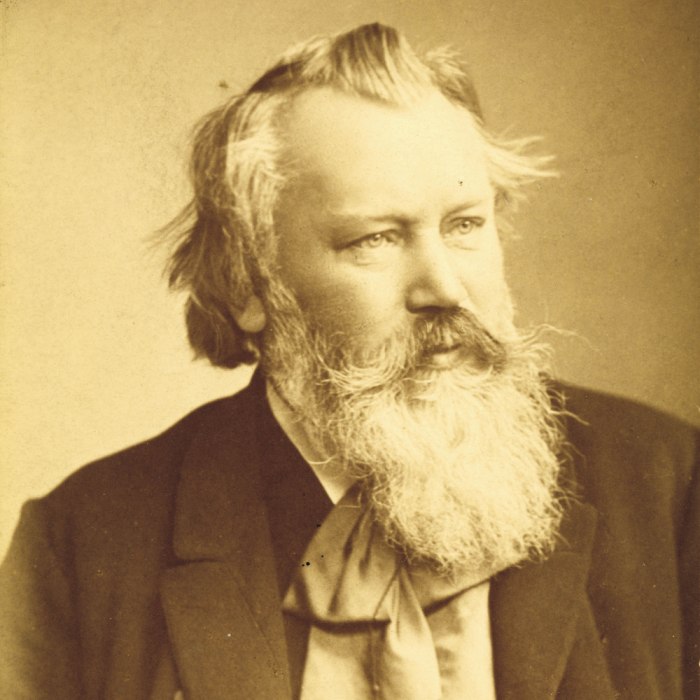
Johannes Brahms (7 May 1833 – 3 April 1897) was a German composer, virtuoso pianist, and conductor of the mid-Romantic period. His music is recognised for its rhythmic vitality and flexible use of dissonance, often combined with carefully crafted yet expressive contrapuntal textures. Brahms adapted traditional forms and techniques from a broad range of earlier composers. His body of work includes four symphonies, four concertos, a Requiem, extensive chamber music, numerous folk-song arrangements, and Lieder, along with compositions for symphony orchestra, piano, organ, and choir. Born into a musical family in Hamburg, Brahms began composing and performing locally during his youth. In adulthood, he toured Central Europe as a pianist, premiering many of his own works and meeting Franz Liszt in Weimar. Brahms collaborated with musicians such as Ede Reményi and Joseph Joachim, seeking the approval of Robert Schumann through the latter. He received strong support and guidance from Robert and Clara Schumann. During Robert Schumann’s mental illness and institutionalisation, Brahms stayed with Clara in Düsseldorf, developing a close and lifelong friendship with her after Robert’s death. Brahms never married, possibly to concentrate on his career as a musician and scholar. He was known to be self-conscious and sometimes highly self-critical. Although innovative, Brahms’s music was considered relatively conservative during the period known as the War of the Romantics, a debate in which he later regretted being publicly involved. His compositions achieved considerable success, gaining a growing circle of supporters and fellow musicians. The critic Eduard Hanslick praised his works as examples of absolute music, and Hans von Bülow regarded Brahms as a successor to Johann Sebastian Bach and Ludwig van Beethoven, a view that Richard Wagner criticised. Brahms settled in Vienna, where he conducted the Singakademie and Gesellschaft der Musikfreunde, programming early and often serious music based on his personal studies. Late in life, he contemplated retiring from composition but continued to write chamber music, especially pieces for Richard Mühlfeld. Brahms’s music gained international importance during his lifetime. His craftsmanship and contributions were admired by contemporaries such as Antonín Dvořák, whose work Brahms enthusiastically supported. Later composers, including Max Reger and Alexander Zemlinsky, found ways to reconcile Brahms’s style with that of Wagner. Arnold Schoenberg emphasised Brahms’s progressive elements, and both Schoenberg and Anton Webern were influenced by the structural coherence of Brahms’s compositions, including the technique Schoenberg called developing variation. Brahms’s music remains a central part of the concert repertoire and continues to influence composers into the 21st century.
Taken from Last.fm
1,600,862 listeners · 21,170,943 plays via Last.fm