Дмитрий Дмитриевич Шостакович
Дмитрий Дмитриевич Шостакович - composer
Person from Russia
Genres: Classical, russian, contemporary classical, 20th Century Classical, composer
Similar artists via Last.fm
 Сергей Васильевич Рахманинов
About Дмитрий Дмитриевич Шостакович
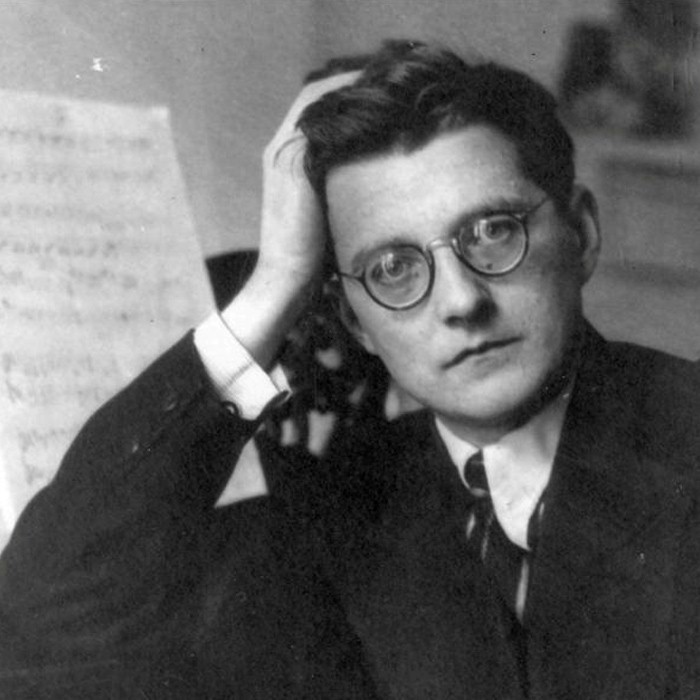
Dmitri Dmitriyevich Shostakovich aka Dmitri Shostakovich (Russian: Дми́трий Дми́триевич Шостако́вич, Dmitrij Dmitrievič Šostakovič) (September 25 [O.S. September 12] 1906, (St Petersburg, Russia) – August 9, 1975) was a Russian composer of the Soviet period. After a period influenced by Sergei Prokofiev and Igor Stravinsky (Symphony No. 1), Shostakovich switched to modernism (Symphony No. 2 and The Nose) before developing a hybrid of styles with the opera "Lady Macbeth of the Mtsensk District" and the ill-fated Fourth Symphony. This hybrid style ranged from the neo-classical (with Stravinskian influences) to the post-romantic music (with Mahlerian influences). His unique approach to tonality involved the use of modal scales and some astringent neo-classical harmonies à la Hindemith and Prokofiev. His music frequently includes sharp contrasts and elements of the grotesque. Shostakovich prided himself on his orchestration, which is clear, economical, and well-projected. This aspect of Shostakovich's technique owes more to Gustav Mahler than Nikolai Rimsky-Korsakov. His greatest works are generally considered to be his symphonies and string quartets, fifteen of each. His works for piano include 2 piano sonatas, an early set of preludes, and a later set of 24 preludes and fugues. Other works include two operas, six concertos, and a substantial quantity of film music. Shostakovich had a complex and difficult relationship with the Soviet government, suffering two official denunciations of his music, in 1936 and 1948, and the periodic banning of his work. At the same time, he received a number of accolades and state awards and served in the Supreme Soviet. Despite the official controversy, his works were popular; he is now held to be, as Grove's judges him, the most talented Soviet composer of his generation. David Fanning concludes in Grove that, "Amid the conflicting pressures of official requirements, the mass suffering of his fellow countrymen, and his personal ideals of humanitarian and public service, he succeeded in forging a musical language of colossal emotional power." Shostakovich is now regarded as "the most popular composer of serious art music of the middle years of the 20th century".
Taken from Last.fm
25,943 listeners · 259,089 plays via Last.fm
On RadioStar
Radio Stations sorted by tracks on rotation
Дмитрий Дмитриевич Шостакович — Top 8 songs
| Artist | Song title | Like / Dislike | |
|---|---|---|---|
| Chostakovitch | Suite jazz n°2: valse n°2 : Orch de Philadelphie / M.Jansons | ||
| Chostakovitch | Fugue pour piano n° 3 : D.Trifonov, piano | ||
| Chostakovitch | Concerto pour piano n°2:2è mvt : C.Ortiz / Royal Philh Orch / V.Ashkenazy | ||
| Chostakovitch | Concerto pour piano & orch n°2: 2e mvt & Finale : B.Giltburg / Philh Liverpool / V.Petrenko | ||
| Chostakovitch | Valse lyrique-arrgt violon & orch : L.Batiashvili / Orch Symph Radio Bavaroise / E-P.Salonen | ||
| Chostakovitch | Le Paon, suite (arr. S.Verhaert): Ouverture : Cuivres de l'Orch Concertgebouw Amsterdam / I.Meylemans | ||
| Chostakovitch | Symphonie n°5:2è mvt : Orch Philh New York / L.Bernstein | ||
| Chostakovitch | Symphonie n°5 : C. Scaglione, dir |