Les Baxter
Les Baxter
Person from United States
Genres: exotica, lounge, jazz, easy listening, space age pop
Similar artists via Last.fm
 Martin Denny
About Les Baxter
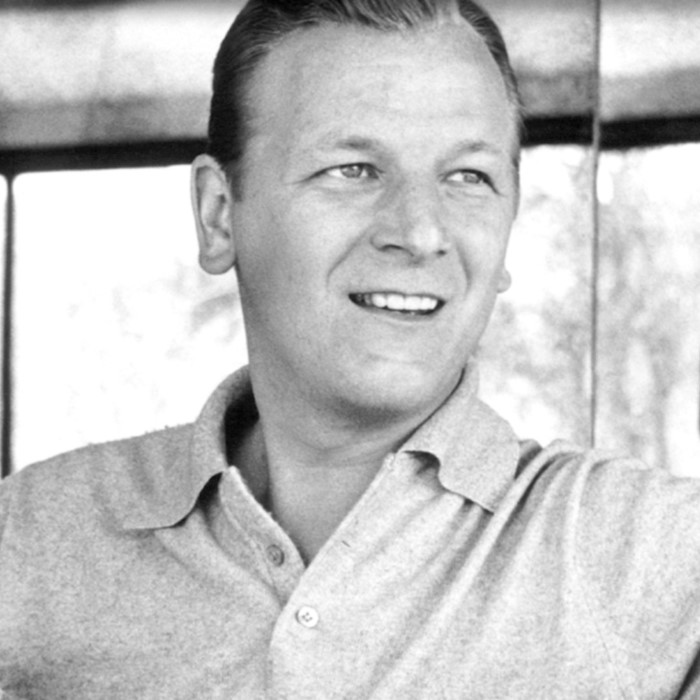
Les Baxter (March 14, 1922 – January 15, 1996) was an American musician and composer. Baxter studied piano at the Detroit Conservatory before moving to Los Angeles for further studies at Pepperdine College. Abandoning a concert career as a pianist, he turned to popular music as a singer. At the age of 23 he joined Mel Tormé's Mel-Tones, singing on Artie Shaw records such as “What Is This Thing Called Love?”. Baxter then turned to arranging and conducting for Capitol Records in 1950, and conducted the orchestra of two early Nat King Cole hits, “Mona Lisa” and “Too Young”. In 1953 he scored his first movie, the sailing travelogue Tanga Tika. With his own orchestra, he released a number of hits including “Ruby” (1953), “Unchained Melody” (1955) and “The Poor People Of Paris” (1956). He also achieved success with concept albums of his own orchestral suites: Le Sacre Du Sauvage, Festival Of The Gnomes, Ports Of Pleasure, and Brazil Now, the first three for Capitol and the fourth on Gene Norman's Crescendo label. The list of musicians on these recordings includes Plas Johnson and Clare Fischer.[citation needed] Baxter also wrote the “Whistle” theme from the TV show Lassie. Baxter did not restrict his activities to recording. As he once told Soundtrack! magazine, “I never turn anything down”. In the 1960s, he formed the Balladeers, a conservative folk group in suits that at one time featured a young David Crosby. He worked in radio as musical director of The Halls of Ivy and the Bob Hope and Abbott and Costello shows. Like his counterparts Henry Mancini and Lalo Schifrin, Baxter later worked for the film industry in the 1960s and 1970s. He worked on movie soundtracks for B-movie studio American International Pictures where he composed and conducted scores for Roger Corman's Edgar Allan Poe films and other horror stories and teenage musicals, including The Pit and the Pendulum, The Comedy of Terrors, Muscle Beach Party, The Dunwich Horror, and Frogs. Howard W. Koch recalled that Baxter composed, orchestrated and recorded the entire score of The Yellow Tomahawk (1954) in a total of three hours for $5,000. When soundtrack work fell off in the 1980s, he scored music for theme parks such as SeaWorld. According to Milt Bernhart, Nelson Riddle was a ghost writer for Baxter when Baxter was working for Nat King Cole. Bernhart states the Riddle told him that Baxter did not write the material on his exotica albums. Bernhart states that, while working for Baxter on recording a score for a Roger Corman film, it was apparent that Baxter could not conduct competently and “couldn't read the scores”. According to Bernhart, “Someone else had written the music.” Gene Lees states that the exotica albums were written by Albert Harris and the material recorded with Yma Sumac was written by Pete Rugolo. According to Rugolo, he was paid $50 per arrangement to ghost for Les Baxter and that he “did a whole album with Yma Sumac”. A comparison of the Baxter album “Space Escapade” and Albert Harris' suite “Bachannal!” recorded by Frank De Vol shows a distinct similarity in both composition and arrangement, leading to the probability that Harris ghost wrote even more for Les Baxter. Nelson Riddle held a grudge against Baxter for taking credit for Riddle's arrangements on two Nat King Cole hit recordings. According to André Previn, when collaborating once with Baxter, in the time Previn and Riddle had finished their parts, Baxter had written just one bar for woodwinds and included a note for the oboe that does not exist on the instrument. Baxter, alongside Martin Denny and Arthur Lyman, is celebrated as one of the progenitors of exotica music. In his 1996 appreciation for Wired magazine, writer David Toop wrote that Baxter “offered package tours in sound, selling tickets to sedentary tourists who wanted to stroll around some taboo emotions before lunch, view a pagan ceremony, go wild in the sun or conjure a demon, all without leaving home hi-fi comforts in the white suburbs.” Les Baxter has a motion picture star on the Hollywood Walk of Fame at 6314 Hollywood Blvd.
Taken from Last.fm
264,832 listeners · 2,730,057 plays via Last.fm
On RadioStar
Radio Stations sorted by tracks on rotation
Les Baxter — Top 30 songs of 113
| Artist | Song title | Like / Dislike | |
|---|---|---|---|
| Les Baxter | April in Portugal | ||
| Les Baxter | Pyramid Of The Sun – 1996 Digital Remaster | ||
| Les Baxter | Taboo (Jojo Effect Rmx) | ||
| Les Baxter | Freeway to Rio | ||
| Les Baxter | Auf Wiederseh’ | ||
| Les Baxter | Auf Wiederseh’n, Sweetheart | ||
| Les Baxter | Milord | ||
| Les Baxter | The Clown On The Eiffel Tower | ||
| Les Baxter | The Poor People Of Paris | ||
| Les Baxter | The Feathered Serpent of the Aztecs | ||
| Les Baxter | Atlantis | ||
| Les Baxter | Balinese Bongos | ||
| Les Baxter | Calcutta | ||
| Les Baxter | I Dig | ||
| Les Baxter | Roller Coaster | ||
| Les Baxter | Shooting Star, Jungalero | ||
| Les Baxter | Voodoo Dreams-Voodoo | ||
| Les Baxter | Simba | ||
| Les Baxter | Love Dance | ||
| Les Baxter | The Lady is Blue | ||
| Les Baxter | High and the Mighty | ||
| Les Baxter | Santa Claus' Party | ||
| Les Baxter | Blue Tango | ||
| Les Baxter | Go Chango | ||
| Les Baxter | Pyramid Of The Sun | ||
| Les Baxter | Jean | ||
| Les Baxter | Venus | ||
| Les Baxter | The Ancient Galleon | ||
| Les Baxter | Amazon Falls | ||
| Les Baxter | Jungalero |