Edvard Grieg
Edvard Grieg - composer
Person from Norway
Genres: Classical, romantic, norwegian, composers, piano
Similar artists via Last.fm
 Robert Schumann
About Edvard Grieg
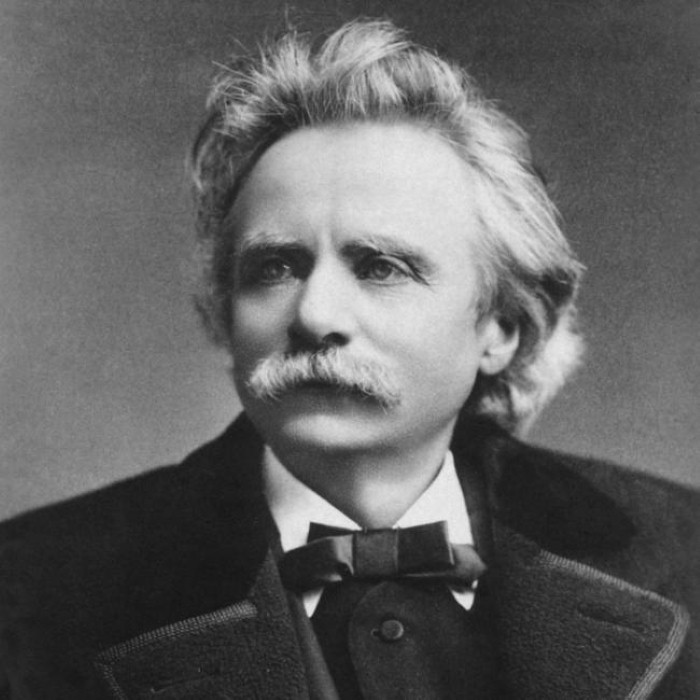
Edvard Hagerup Grieg (15 June 1843 – 4 September 1907) was a Norwegian composer and pianist. He is widely considered one of the leading Romantic era composers, and his music is part of the standard classical repertoire worldwide. His use and development of Norwegian folk music in his own compositions put the music of Norway in the international spectrum, as well as helping to develop a national identity, much as Jean Sibelius and Antonín Dvořák did in Finland and Bohemia, respectively. Edvard Grieg is the most celebrated person from the city of Bergen, with numerous statues depicting his image, and many cultural entities named after him: the city's largest concert building (Grieghallen), its most advanced music school (Grieg Academy) and its professional choir (Edvard Grieg Kor). The Edvard Grieg Museum at Grieg's former home, Troldhaugen, is dedicated to his legacy. Grieg was born in Bergen, Norway on 15 June 1843. His ancestors were Scottish, the original family name was spelled "Greig". After the Battle of Culloden in 1746, his great-grandfather travelled widely, settling in Norway around 1770, and establishing business interests in Bergen. Grieg was raised in a musical home. His mother, Gesine, became his first piano teacher. He studied in several schools including Tank's School, and often brought in examples of his music to class. In the summer of 1858, Grieg met the eminent Norwegian violinist virtuoso Ole Bull, who was a friend of the family, and whose brother was married to Grieg's aunt. Bull noticed the 15-year-old boy's talent and persuaded his parents to send him to further develop his talents at the Leipzig Conservatory, then directed by Ignaz Moscheles. Grieg enrolled in the conservatory, concentrating on the piano, and enjoyed the numerous concerts and recitals given in Leipzig. He disliked the discipline of the conservatory course of study, yet he still achieved very good grades in most areas, the exception being the organ, which was mandatory for piano students at the time. In the spring of 1860, he survived the life-threatening lung disease, pleurisy, which would effect his health for the rest of his life. The following year he made his debut as a concert pianist, in Karlshamn, Sweden. In 1862, he finished his studies in Leipzig, and held his first concert in his home town of Bergen, where his programme included Ludwig van Beethoven's Pathétique sonata. (Grieg's own recording of his Piano Sonata, made late in his life, shows he was an excellent pianist). In 1863, Grieg went to Copenhagen, Denmark, and stayed there for three years. He met the Danish composers J. P. E. Hartmann, and Niels Gade. He also met his fellow Norwegian composer Rikard Nordraak (composer of the Norwegian national anthem), who became a good friend and source of great inspiration. Nordraak died shortly after, and Grieg composed a funeral march in his honor. Grieg had close ties with the Bergen Philharmonic Orchestra (Harmonien) and was Music Director of the orchestra from 1880–1882. On 11 June 1867, Grieg married his first cousin, Nina Hagerup. The next year their only child, Alexandra, was born. The following summer, Grieg wrote his Piano Concerto in A minor while on holiday in Denmark. Edmund Neupert gave the concerto its premiere performance on 3 April 1869 in the Casino Theater in Copenhagen. Grieg himself was unable to be there due to commitments conducting in Christiania (as Oslo was then named). In the summer of 1869, Grieg's daughter Alexandra became ill and died, at the age of 13 months. In 1868, Franz Liszt, who up to that time had not met Grieg, wrote a testimonial for him to the Norwegian Ministry of Education, which led to Grieg obtaining a travel grant as well as a pension from the Norwegian government. The two finally met in Rome in April, 1870. On Grieg's first visit, the two went over Grieg's Violin Sonata No. 1, which pleased Liszt greatly. On the second day of his visit, Grieg brought with him the manuscript of his Piano Concerto in A minor, which Liszt proceeded to sightread (including the orchestral arrangement). Liszt's rendition greatly impressed his audience, although Grieg gently pointed out to him that he played the first movement too quickly. Liszt also gave Grieg some advice on orchestration (e.g. to give the melody of the second theme in the first movement to a solo trumpet) as well as the encouragement to become a great composer. In 1876, Grieg created incidental music for the premiere of Ibsen's play Peer Gynt, at the request of the author. Many of the pieces from this work became very popular in the form of orchestral suites or piano and piano-duet arrangements. In 1888, Grieg met Tchaikovsky in Leipzig. Both men appreciated each other's works and were great friends, attending each other's concerts and writing each other letters. Their correspondence ended in 1888 for unknown reasons. In the spring 1903, Grieg made nine 78-rpm gramophone recordings of his piano music in Paris; all of these historic discs have been reissued on both LPs and CDs and, despite limited fidelity, show his artistry as a pianist. Grieg also made live-recording player piano music rolls for the Welte-Mignon reproducing system, all of which survive today and can be heard. Edvard Grieg died in the autumn of 1907, aged 64, after a long period of illness. His final words were "Well, if it must be so". The funeral drew between 30,000 and 40,000 people out on the streets of his home town to honour him. Following his wish, his own funeral march for Rikard Nordraak as well "Last Spring" were played in an orchestration by his friend Johan Halvorsen, who had married Grieg's niece. In addition, the famous funeral march from Frédéric Chopin's third movement from his Second Sonata were played. His and his wife's ashes are entombed in a mountain crypt near his house, Troldhaugen, which is near Bergen, Norway.
Taken from Last.fm
1,354,916 listeners · 14,328,523 plays via Last.fm