Ravi Shankar
Ravi Shankar
Person from India
Genres: Indian, sitar, indian classical, world, World Music
Similar artists via Last.fm
 Anoushka Shankar
About Ravi Shankar
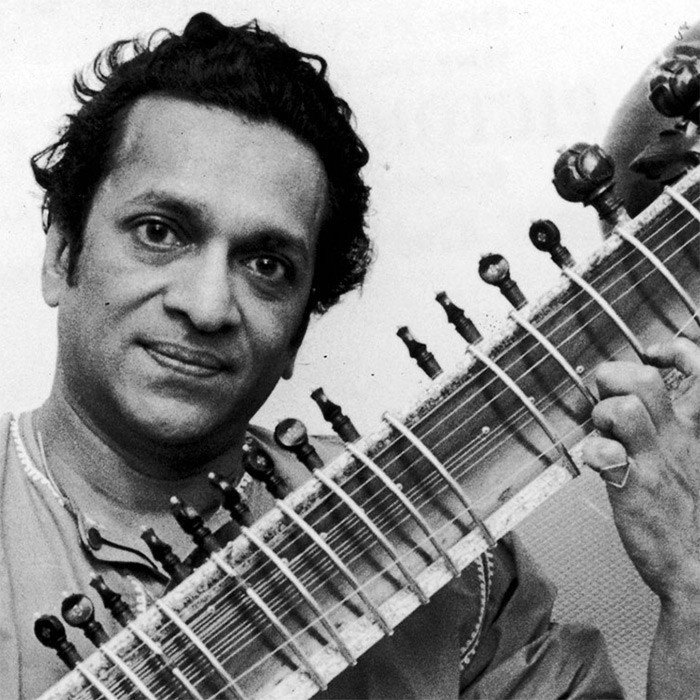
Ravi Shankar (7 April 1920 – 11 December 2012), often referred to by the title Pandit, was a multiple Grammy Award-winning Indian musician best known for his virtuosity on the sitar. Shankar was awarded the three highest national civil honours of India: the Padma Bhushan, in 1967, the Padma Vibhushan, in 1981, and the Bharat Ratna, in 1999. He has received honours from the UNESCO International Music Council, three Grammy Awards, a Magsaysay award, a Légion d'honneur and was nominated for an Academy Award. He was also a posthumous recipient of the lifetime-achievement Grammy in 2012. Grammy award-winning singer Norah Jones and Anoushka Shankar, also a Grammy-nominated sitarist, are among his three children. Born on 7th April 1920 in Varanasi, Uttar Pradesh, India into an orthodox, well-off Brahmin family, Rabindra Shankar Chowdery's father, ShyÆm Shankar, was employed as a diwan (minister) by the Maharajah of Jhalawar. By the age of 13, Ravi Shankar was going along on every tour of his brother Uday Shankar's Compagnie de Danse et Musique Hindoue (Company of Hindu Dance and Music). At the All-Bengali Music Conference in December 1934, he met the multi-instrumentalist Allauddin Khan. Precisely when Allauddin Khan was born is uncertain. People hazard dates in the 1860s around 1862, but in later years he himself gave his age haphazardly. He would transform many musicians' lives, but he had an incalculable effect on Ali Akbar (his son), Annapurna Devi (his daughter), and Shankar himself. Allauddin Khan joined Uday's troupe as its principal soloist around 1935-1936. In 1938, Shankar gave up a potential career as a dancer and went to study with Allauddin Khan in Maihar. In 1939, he began giving public recitals and came out of training at the end of 1944. Until 1948, he based himself in Bombay and gave programs all over India. He toured and wrote for films and ballet. Around this time he began his recording career with a small session for HMV (India). Work for All India Radio followed; as music director from February 1949 to January 1956 in New Delhi. Concurrently, his international star was on the rise. In 1954, he performed in the Soviet Union. In 1956, he played his debut solo concerts in Western Europe and the U.S. Within a decade he would be the most famous Indian musician on the planet. Within two decades he would become probably the most famous Indian alive. His English-language autobiography, My Music, My Life (1969), is still one of the best general introductions to Hindustani music. Shankar is not one-dimensional. Apart from pursuing a career as a classical performer, he has also experimented outside this field. For this reason he has attracted criticism from purists. Some of this, especially during the Beatles era, undoubtedly had an element of jealousy to it; some was certainly warranted, because Shankar did take many chances. In fact, that was one of the things that kept his music exciting. To use a cricketing image - baseball would be wholly inappropriate - Shankar's batting average has remained high throughout a long and illustrious career. He is the father of both Grammy award winning singer Norah Jones, and Anoushka Shankar, also a noted sitarist. On 6 December 2012, Shankar was admitted to Scripps Memorial Hospital in La Jolla, San Diego, California after complaining of breathing difficulties. He died on 11 December 2012 at around 16:30 PST, at a hospital near his home in Encinitas, California. The Ravi Shankar Foundation issued a statement that read Shankar had suffered from upper-respiratory and heart issues over the past year and underwent heart-valve replacement surgery on 6 December 2012.
Taken from Last.fm
264,154 listeners · 3,815,381 plays via Last.fm
On RadioStar
Radio Stations sorted by tracks on rotation
Ravi Shankar — Top 30 songs of 111
| Artist | Song title | Like / Dislike | |
|---|---|---|---|
| Ravi Shankar | Raga Haushi Kanhara | ||
| Ravi Shankar | Raga Kausi Kanhra | ||
| Ravi Shankar | Frequent Flyer | ||
| Ravi Shankar | Raag Pancham Se Ghara (Early Evening Raag) | ||
| Ravi Shankar | Reflection | ||
| Ravi Shankar | Dhun Tala Dadra | ||
| Ravi Shankar | Raga Multani | ||
| Ravi Shankar | I Am Missing You | ||
| Ravi Shankar | fire night | ||
| Ravi Shankar | Philip Glass - Sadhanipa | ||
| Ravi Shankar | Yama Kalyan | ||
| Ravi Shankar | Dadra | ||
| Ravi Shankar | Genesis Theme (Hi Perspective Mix) | ||
| Ravi Shankar | The Sound Of India (Shigeto's Sun And Hash Edit) | ||
| Ravi Shankar | Dhun | ||
| Ravi Shankar | Svara Mantra | ||
| Ravi Shankar | Sahanaa Vavavtu | ||
| Ravi Shankar | Vandanaa Trayee | ||
| Ravi Shankar | Friar Park | ||
| Ravi Shankar | Song from the Hills | ||
| Ravi Shankar | Alap, Jod and Jhala | ||
| Ravi Shankar | Ali Akbar Khan | ||
| Ravi Shankar | Dhun Kafi | ||
| Ravi Shankar | Dhun [Dadra and Fast Teental] | ||
| Ravi Shankar | Farewell My Friend (Raga: Rajya-Kalyan) | ||
| Ravi Shankar | Improvisations on the theme music from 'Panther Panchali' | ||
| Ravi Shankar | Karnataki | ||
| Ravi Shankar | Nata Bhairavi | ||
| Ravi Shankar | Raga Des | ||
| Ravi Shankar | Raga Hameer (Alap, Gat I, Gat II) Tala Tintal |