Neerlands Hoop in Bange Dagen
Neerlands Hoop in Bange Dagen
Group from Netherlands
Genres: cabaret, comedy, dutch, 70s, Nederlandstalig
Similar artists via Last.fm
 Freek de Jonge
About Neerlands Hoop in Bange Dagen
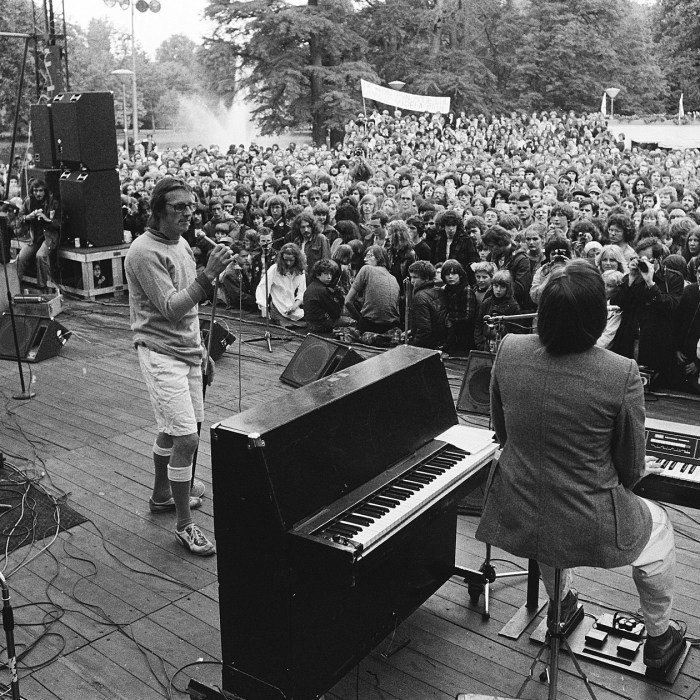
Neerlands Hoop in Bange Dagen (often referred to simply as Neerlands Hoop or, colloquially, Bram & Freek) was a Dutch comedy/cabaret duo based in Amsterdam, active from 1968 to 1979. They are legendary in The Netherlands for their activist theatre shows with rock 'n roll intensity. Successful in their native Netherlands and the Flemish-speaking part of Belgium throughout the 1970s, Neerlands Hoop were praised for the music in their shows. Comprising Freek de Jonge (sketches) and Bram Vermeulen (music), Neerlands Hoop is widely regarded as the most innovative and influential Dutch-language cabaret act of all time, a duo that changed the face, tone and temperament of Dutch comedy (and the Dutch theatre tradition as a whole). Freek de Jonge, Bram Vermeulen and Johan Gertenbach first met in 1967 as students at Amsterdam University. They shared a love of music, wanted to 'do something' on stage and recorded a somewhat hippie-esque debut single under the name De Paradijsvogels, after which they moved on the become the cabaret trio Cabariolet. Partly due to a lack of success, Gertenbach left the group. Bram and Freek carried on as a duo, soon changing their name into Neerlands Hoop in Bange Dagen: 'Netherlands' Hope in Anxious Days' or, in short, 'Dutch Hope'. Music was a key ingredient of their performances from the outset, with Vermeulen playing a buzzing Hammond organ. Fiercely left wing and provokingly anti-establishment, Neerlands Hoop hit small theatres with their debut stage show, Neerlands Hoop, in early 1968. They participated in the country's most prestigious cabaret festival, Cameretten Festival in 1968... and disappointingly finished 5th. Nonetheless, they were to become the voice of a young, progressive Dutch generation. June 1969 saw them embarking on a lengthy theatre tour with their first full-length show: the Dutch Music & Comedy Show Neerlands Hoop in Bange Dagen. It was an overnight succes. The songs from the first show ended up on a studio LP called Neerlands Hoop in Bange Dagen (1970), whereas the LP 'Live' in Wadway (N.H.) (1971, listed on streaming platforms as Live in Wadway) gives a good impression of their frantic, high-pace, shouty live performance of the time. Their second full-length stage show, Neerlands Hoop in Panama (premiere: September 1971), was an even greater success, with Neerlands Hoop touring theatres in The Netherlands and Flanders for two full seasons. Once again they released a studio LP of songs from the era (Neerlands Hoop in Panama, 1971) as well as a live double LP containing the show in full, released when the tours were finally over: Weerzien in Panama (Live) (1973). In between the legs of the 'Panama' tour, Neerlands Hoop played a short show for a shorter while, written especially for the 1972 Holland Festival in Amsterdam, entitled Plankenkoorts ('Stage Fright'), which was released on LP in 1972: Plankenkoorts (Live). Neerlands Hoop were a music group at heart, which led in 1973 to the formation of a fully-fledged rock band, featuring De Jonge, Vermeulen, Thé Lau (guitar), Jan de Hont (bass) and Harry Heeren (drums). Neerlands Hoop's third full-length theatre show, Neerlands Hoop Express (premier: September 1973), was a loud rock revue more than anything else, "noisy and infantile" according to some critics, a groundbreaking experience according to others. A full live registration on double LP, Neerlands Hoop Express (Live), came out in 1974. Following the 'Express' tour Neerlands Hoop decided it was time for some special projects. They signed a contract with TV network, VARA, for seven TV specials, which were anarchistic and highly successful. They did another short theatre show, this time for the Dutch Boekenweek ('Book Week') of 1975, entitled Neerlands Hoop in genaaid of gebonden. It came out on LP, as usual: Neerlands Hoop In Genaaid of Gebonden (Live) (1975). De Jonge and Vermeulen wrote a 'rock opera' (of sorts) entitled, Een kannibaal als jij en ik ('A Cannibal Like You and Me'), which hit Dutch theatres in late 1975. Bram and Freek did not appear on stage themselves. The cast had a high 'cult factor', featuring popular Dutch actors such as Bill van Dijk and Corrie van Gorp. For the first time in years Neerlands Hoop experienced negative reviews and tepid crowd reactions. The opera bombed (and so did the LP, which was formally credited to Freek de Jonge and Bram Vermeulen rather than Neerlands Hoop). Financial trouble for their production company ensued. Neerlands Hoop reverted to their success formula and wrote their fourth major theatre show, Neerlands Hoop Interieur, which premiered in February 1976. They returned to winning ways, got rave reviews and performed the show over 400 times in sold-out venues in The Netherlands and Flanders between 1976 and 1978. The double LP, Neerlands Hoop Interieur (Live) (1977), was also a commercial success. Another commercial succes was their studio LP, Hoezo jeugdsentiment?... (1976), containing Neerlands Hoop interpretations of popular songs from Bram and Freek's childhood and teenage years. The LP was performed live, one-off, at Amsterdam's Carré theatre on 13 September 1976, after which the tremendously successful Interieur went on tour for a second season, this time with Jan de Hont (guitar, vocals) as an official third member of Neerlands Hoop. De Hont's presence drastically changed the dynamic of the show, which was recorded once again. Live excerpts and songs (including a few new ones added to the show) were released on an LP entitled Heimwee naar Holland (1978). The title means 'Homesick for Holland', referring to the fact that the recordings were made live in Brussels, Belgium. After the Interieur tours Neerlands Hoop launched another of their shorter productions. Bloed aan de paal (1978), meaning 'Blood on the post', was Neerlands Hoop's attempt to get the Netherlands national football team to boycott the 1978 World Cup in Argentina, a military dictatorship at the time. The Oranje did not stay at home, but the show and subsequent LP (Bloed aan de Paal, early 1978) were very successful. On to the next project: a studio LP of new pop songs, entitled Ik ben volmaakt gelukkig ('I am perfectly happy'), released in the summer of 1979. Neerlands Hoop now sounded like a slightly New Wave-y pop band, featuring Freek de Jonge on drums (!). 13 September 1978 saw the premiere of the fifth (and, as it were, final) Neerlands Hoop theatre show, entitled Offsmoet Ipq Dpef, an abstract title which (using the so-called 'Caesar rotation' decoding format: B = A) unveiled the show's actual title, Neerlands Hoop Code. It featured some of Neerlands Hoop's loudest and darkest punk and New Wave music, in between De Jonge's abstract and expressionist sketches about madness, mental institutions and paranoia. The show was slaughtered by critics, leading to tensions. Halfway the 'Code' tour, Neerlands Hoop wrote a short show in English, entitled Dutch Hope. They travelled to London for seven performances in a small theatre, to enthusiastic crowd reactions and remarkably good reviews. Back in The Netherlands, De Jonge dropped the bomb on Vermeulen: he had decided it was time for him to move and become a solo comedian. The approaching end of Neerlands Hoop in Bange Dagen was made public on 11 September 1979, with more than two months of 'Code' touring still ahead. The tour dragged on amidst great tension between De Jonge and Vermeulen, who hardly spoke anymore, with Jan de Hont providing moral support to the devastated Vermeulen - and De Jonge mostly traveling from city to city alone. The final Neerlands Hoop performance was on 23 December 1979 in Haarlem, The Netherlands, marking the awkward, painful and bitter end of the most legendary 'rock & roll comedy' duo the Dutch language area ever saw. Bram Vermeulen had a respectable solo career as a composer, singer-songwriter, theatre maker and TV host, but (to his frustration and sorrow) felt that Neerlands Hoop kept haunting him, whatever he did. Vermeulen died unexpectedly, after cardiac arrest, on holiday in Italy, in 2004. Freek de Jonge embarked on his solo career in 1980: De Komiek was the first of a long list of immensely successful solo shows. He is one of The Netherlands' great comedians and stage artists, still notoriously prolific and energetic in 2024, the year of his 80th birthday. When Vermeulen unexpectedly died in 2004, De Jonge said, remorsefully: "I think I spoke to Bram about eight times since Neerlands Hoop - and in six of those cases the conversation was unfriendly." De Jonge has spoken about Vermeulen with love and respect since. As an elder statesman of Dutch comedy and cabaret, he started incorporating occasional Neerlands Hoop songs and references in his solo shows. He celebrated the 50th anniversary of Neerland's Hoop's foundation with a special show at the Carré in Amsterdam in 2018, entitled Neerlands Hoop in Concert, paying hommage to Vermeulen. Albums Neerlands Hoop in Bange Dagen (1970) (studio album; songs and sketches) Live in Wadway (N.H.) (1971) (live theatre show; songs and sketches) Neerlands Hoop in Panama (1971) (studio album; songs) Plankenkoorts (Live) (1972) (live theatre show; songs and sketches) Weerzien in Panama (Live) (1973 (live theatre show; songs and sketches) Neerlands Hoop Express (Live) (1974) (live theatre show; songs and sketches) Neerlands Hoop in genaaid of gebonden (Live) (1975) (live theatre show; songs and sketches) 28 Liedjes van Bram en Freek (1975) (compilation; songs) Hoezo jeugdsentiment? (1976) (studio album; songs) Een kannibaal als jij en ik (1976) (live theatre show; songs and sketches) Neerlands Hoop Interieur (Live) (1977) (live theatre show; songs and sketches) Heimwee naar Holland (1977) (live songs from the 'Interieur' tour) Bloed aan de paal (1978) (live theatre show; sketches and music) Ik ben volmaakt gelukkig (1978) (studio album; songs) Offsmboet Ippq Dpef (Live) (1979) (live theatre show; sketches and music) De Toetjes (1981) (compilation, unreleased recordings)
Taken from Last.fm
1,417 listeners · 21,798 plays via Last.fm