Jean-Baptiste Senaillé
Jean-Baptiste Senaillé - French composer
Person from France
Genres: french, baroque, 18th century
Similar artists via Last.fm
 Jean-Marie Leclair
About Jean-Baptiste Senaillé
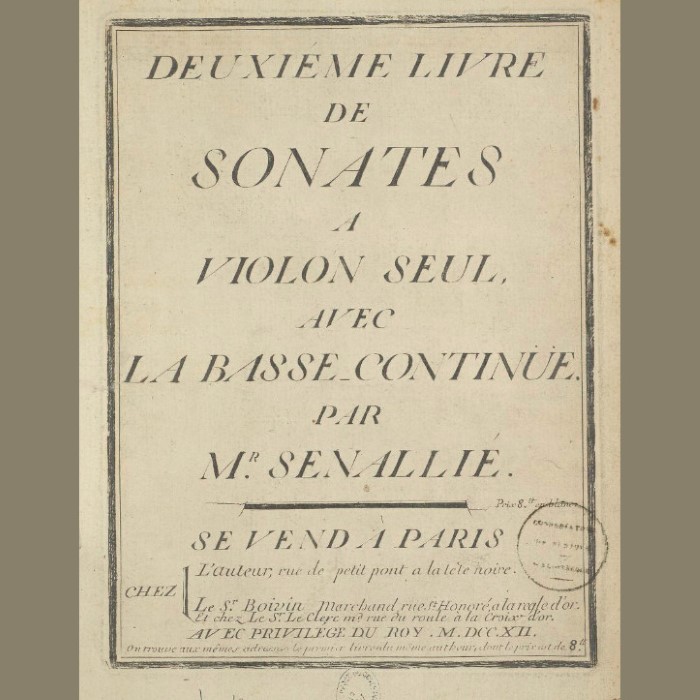
Jean-Baptiste Senaillé (Paris, 23 November 1687 – Paris, 2 September 1730) was one of the most distinguished French violinists and composers of the early eighteenth century, a central figure in the generation that absorbed Italian virtuosity into the French instrumental tradition. Born in Paris into a family of musicians, he was the brother of Jean-Baptiste Anet, another prominent violinist, and received his earliest training in the highly disciplined environment of the Chapelle Royale, where he became known as a precocious performer. Like several of his contemporaries, Senaillé completed his musical education in Italy, spending time in Rome around 1710–1715, where he encountered the works of Corelli and the emerging Roman sonata style. This Italian experience decisively shaped his musical language. On his return to Paris, Senaillé rapidly established himself as one of the city’s leading violin virtuosi. He became a regular performer at the Concert Spirituel, the most important public concert series in France, and was widely admired for a style that combined Italian brilliance with French refinement. Contemporary commentators praised the elegance and expressivity of his playing rather than sheer technical display, qualities that are mirrored in his compositions. In 1720 he was appointed ordinaire de la musique de la Chambre du Roi, confirming his standing within the royal musical establishment while allowing him to continue performing in public venues. Senaillé’s surviving output consists primarily of sonatas for violin and basso continuo, published in several books between 1719 and 1727. These sonatas occupy a stylistic middle ground between Corelli and Leclair: formally Italianate, typically in four movements, but enriched with French dance rhythms, ornamentation, and a nuanced approach to affect. They demand considerable technical skill from the violinist, including rapid passagework, expressive cantabile writing, and controlled use of double stopping, yet they never abandon clarity of line or balance. Senaillé’s career was cut short by his premature death in 1730, but his sonatas continued to circulate and to be admired well into the mid-eighteenth century, securing his place among the most important French violin composers of his era.
Taken from Last.fm
242 listeners · 2,625 plays via Last.fm