Tangerine Dream
No live data for this exact artist credit
We haven't currently observed any radio station playing this exact artist string. This often happens with multi-artist or featuring credits (e.g. "Artist A feat. Artist B") that are short-lived in stream metadata.
Try searching for one of the individual artists in the credit, or browse what's playing now.
Tangerine Dream
Group from Germany
Genres: ambient, berlin school, electronic, krautrock, new age, progressive electronic, progressive rock, Progressive rock
Similar artists via Last.fm
 Edgar Froese
About Tangerine Dream
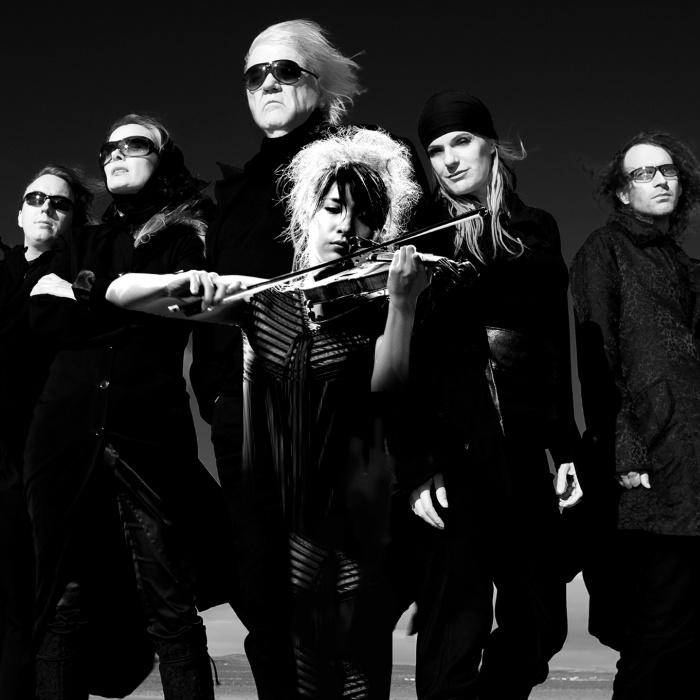
Tangerine Dream is a German electronic music group founded in 1967 by Edgar Froese. The band has undergone numerous personnel changes throughout its history, with Froese remaining the only constant member until his death in January 2015. One of the group's best-known lineups consisted of Froese, Christopher Franke, and Peter Baumann during the mid-1970s. Johannes Schmoelling replaced Baumann in 1979 and remained with the group until 1985. This period was associated with the band's work on film soundtracks. Following Froese's death, the group continued under the leadership of Thorsten Quaeschning, who joined in 2005 and had been designated by Froese as his successor. Quaeschning has performed alongside violinist Hoshiko Yamane, a member since 2011, and Paul Frick, who joined in 2020. Between 2014 and 2020, Quaeschning and Yamane also performed with Ulrich Schnauss, who appeared in several live performances with Froese shortly before his death. Tangerine Dream is regarded as an influential group in electronic music. Its early recordings for the Ohr label contributed to the development of the German music movement known as kosmische Musik, or "cosmic music". During the period commonly referred to as the "Virgin Years", named after the group's association with Virgin Records, the band released albums including "Phaedra" (1974) and "Rubycon" (1975), both of which incorporated synthesizers and sequencers extensively and achieved commercial success in the United Kingdom. The group also became known for composing more than 60 film soundtracks. From the late 1990s onward, Tangerine Dream explored a range of instrumental and electronic styles while continuing to release a large volume of recordings, including more than 100 albums. The group also contributed music to the video game "Grand Theft Auto V". Their work from the mid-1970s has been cited as influential on genres such as new-age music and electronic dance music. On 29 September 2017, the band released the studio album "Quantum Gate". In December 2019, it issued "Recurring Dreams", a collection of newly recorded versions of earlier compositions. On 26 November 2021, the group released the EP "Probe 6-8", which included the tracks "Raum", "Para Guy", and "Continuum". The EP's themes were later expanded upon in the studio album "Raum", released on 25 February 2022. Edgar Froese moved to West Berlin during the mid-1960s to study art. Before forming Tangerine Dream, he played in the psychedelic rock band The Ones, which released a single before disbanding. Froese subsequently experimented with various musical concepts and performed with different musicians, often at the Zodiak Free Arts Lab. Some performances combined music with literature, painting, and multimedia elements. According to accounts by Froese, the band's name originated from a mishearing of the phrase "tangerine trees and marmalade skies" from the Beatles song "Lucy in the Sky with Diamonds". Froese developed an interest in music technology and experimented with tape loops, custom-built instruments, and recorded sounds. These techniques anticipated later developments in sequencer-based electronic music. Tangerine Dream's debut album, "Electronic Meditation", was released in 1970 on the Ohr label. The album featured a lineup of Froese, Klaus Schulze, and Conrad Schnitzler, and combined elements of krautrock and tape-collage experimentation rather than the synthesizer-oriented sound associated with the band's later work. This era later became known as the "Pink Years", in reference to the Ohr label logo. Subsequent albums, beginning with "Alpha Centauri", placed greater emphasis on electronic instruments. During the early 1970s, the band's sound prominently featured organ performances by Steve Schroyder and later Peter Baumann, alongside guitar by Froese and drums by Christopher Franke. The Mellotron also became a major component of the group's sound. The 1973 album "Atem" received attention after British radio presenter John Peel selected it as one of his records of the year. This exposure contributed to the band's signing with Virgin Records. The following album, "Phaedra", reached number 15 on the UK Albums Chart and became one of Virgin's early commercial successes. The album made extensive use of sequencers and is considered one of the early commercially successful electronic music recordings to do so. During this period, the Mellotron remained a central instrument in the group's sound. In the 1980s, Tangerine Dream adopted digital synthesizer technology alongside other electronic music artists such as Jean-Michel Jarre and Vangelis. Froese later collaborated with Jarre on the album "Electronica 1: The Time Machine" in 2015. The group's experience with custom-built instruments and experimental sound production contributed to its adaptation of emerging digital technologies. The band's early live performances were visually minimal, often featuring musicians seated among electronic equipment with limited stage lighting. Some concerts were performed in near darkness, including an appearance at York Minster on 20 October 1975. As concert technology advanced, the group's performances incorporated lighting effects, lasers, pyrotechnics, and projected visuals. By 1977, its North American tour included Laserium effects. Throughout the 1970s and 1980s, Tangerine Dream toured extensively. Concerts frequently featured improvised and unreleased material, leading to the circulation of numerous bootleg recordings. Several official live albums documented these performances, and some concert material later formed the basis of studio compositions. Most Tangerine Dream recordings are instrumental. Albums that prominently featured vocals included "Cyclone" (1978) and "Tyger" (1987). Additional vocal performances appeared on individual tracks such as "Kiew Mission" from "Exit" and "The Harbor" from the soundtrack album "Shy People". The group later incorporated vocals more extensively in projects based on Dante Alighieri's "Divine Comedy", followed by the albums "Madcap's Flaming Duty" (2007) and "Under Cover - Chapter One" (2010). Following a performance in East Berlin in 1980, the group became one of the first major Western bands to perform in a communist country. The live album "Poland", recorded during a tour at the end of 1983, marked the beginning of the period referred to as the "Blue Years" and coincided with a move to the Jive Electro label. During the 1980s, Tangerine Dream composed music for more than 20 films. Froese had previously worked on film music in the late 1960s, including the experimental film "Auf Scheißer schießt man nicht". Many soundtrack recordings incorporated reworked material from studio projects. Among the group's better-known soundtracks are "Sorcerer", "Thief", "Legend", "Risky Business", "The Keep", "Firestarter", "Flashpoint", "Heartbreakers", "Shy People", and "Near Dark". The group also composed music for the television series "Street Hawk" and later contributed music stems for the video game "Grand Theft Auto V". In 2016, Tangerine Dream released its own version of the theme from the television series "Stranger Things", whose music had drawn influence from the band. Several albums released during the 1990s received Grammy Award nominations. During this period, Tangerine Dream, including Jerome Froese, explored styles associated with electronica, moving away from some of the new-age influences of earlier recordings. After Jerome Froese left the group in 2006 to pursue a solo career, Edgar Froese continued directing the band's musical output. In later years, Tangerine Dream released several themed series of recordings. These included the "Dream Mixes" series, issued between 1995 and 2010, the "Divine Comedy" series inspired by Dante Alighieri, the "Five Atomic Seasons" releases from 2007 to 2010, and the "Eastgate Sonic Poems" series based on writers such as Edgar Allan Poe and Franz Kafka. Beginning in 2007, the group also released a number of EPs referred to as "CupDiscs". Edgar Froese maintained a solo recording career in parallel with Tangerine Dream. Jerome Froese also released solo material under the names TDJ Rome and Jerome Froese. In 2011, Jerome Froese collaborated with former Tangerine Dream member Johannes Schmoelling and keyboardist Robert Waters to form the group Loom. Thorsten Quaeschning, founder of Picture Palace Music, joined Tangerine Dream in 2005 and contributed to many later recordings. Over the course of its career, the band was associated with labels including Ohr, Virgin, Jive Electro, Private Music, Miramar, TDI, Eastgate, and Kscope. Since 2017, Kscope has released the group's studio albums "Quantum Gate", "Recurring Dreams", and "Raum". Tangerine Dream continued touring extensively during the 2000s and 2010s. In 2007, the band celebrated its 40th anniversary with performances in London, Eberswalde, and Frankfurt. Additional appearances followed across Europe and North America. In 2010, the group performed at the Royal Albert Hall in London, 35 years after an earlier concert at the venue in 1975. The performance was later released as a live album titled "Zeitgeist". The group also toured Europe, Canada, and the United States in 2012 under the name "The Electric Mandarine Tour 2012". Froese's final performances with the band took place in Melbourne, Australia, in November 2014. Edgar Froese died in Vienna on 20 January 2015 as a result of a pulmonary embolism. In April 2015, the remaining members of Tangerine Dream announced their intention to continue the project in accordance with Froese's plans. The band's first concert after his death took place in Szczecin, Poland, on 9 June 2016. The 2017 album "Quantum Gate" was developed from musical ideas and sketches left by Froese and completed by the remaining members. In 2020, the group reissued "Recurring Dreams" internationally through Kscope in connection with the "Tangerine Dream: Zeitraffer" exhibition at the Barbican Centre in London. Paul Frick officially joined the band on 9 June 2020 after previously performing as a guest musician. He became the first member to join the group after Froese's death and the first member who had not met Froese personally. In June 2021, Ulrich Schnauss announced that he would no longer perform live with the group. In 2023, Tangerine Dream undertook what was described as the largest tour in the band's history, with performances across Europe and North America, including concerts in Portugal, Switzerland, the Netherlands, Belgium, France, Poland, Romania, the United States, Canada, Germany, and the United Kingdom. Full Wikipedia article: https://en.wikipedia.org/wiki/Tangerine_Dream Discography Electronic Meditation (1970) Alpha Centauri (1971) Zeit (1972) Atem (1973) Phaedra (1974) Rubycon (1975) Ricochet (1975) (Live/Studio) Stratosfear (1976) Sorcerer (1977) (Soundtrack) Encore (1977) (Live/Studio) Cyclone (1978) Force Majeure (1979) Tangram (1980) Quichotte (1981) (Live/Studio) Thief (1981) (Soundtrack) Exit (1981) White Eagle (1982) Logos (1982) (Live/Studio) Hyperborea (1983) Wavelength (1983) (Soundtrack) Risky Business (1984) (Soundtrack) Firestarter (1984) (Soundtrack) Flashpoint (1984) (Soundtrack) Poland (1984) (Live/Studio) Heartbreakers (1985) (Soundtrack) Le Parc (1985) Green Desert (1986) (recorded 1973) Legend (1986) (Soundtrack) Underwater Sunlight (1986) Tyger (1987) Canyon Dreams (1987) (Video album, issued on CD 1991) Three O'Clock High (1987) (Soundtrack) Near Dark (1988) (Soundtrack) Shy People (1988) (Soundtrack) Livemiles (1988) (Live/Studio) Optical Race (1988) Miracle Mile (1989) (Soundtrack) Lily on the Beach (1989) Destination Berlin (1989) (Soundtrack) Melrose (1990) Dead Solid Perfect (1991) (Soundtrack, recorded 1988) The Park Is Mine (1991) (Soundtrack, recorded 1985) L'Affaire Wallraff (The Man Inside) (1991) (Soundtrack, recorded 1989) Rockoon (1992) Rumpelstiltskin (1992) (Soundtrack) Quinoa (1992) Deadly Care (1992) (Soundtrack, recorded 1987) 220 Volt (1993) (Live/Studio) Turn of the Tides (1994) Catch Me If You Can (1994) (Soundtrack, recorded 1989) Tyranny of Beauty (1995) The Dream Mixes (1995) (Remixes/Studio) Zoning (1996) (Soundtrack, recorded 1994) Goblins' Club (1996) Oasis (1997) (Video album/CD soundtrack) TimeSquare – Dream Mixes II (1997) (Remixes/Studio) Ambient Monkeys (1997) The Hollywood Years Vol. 1 (1998) The Hollywood Years Vol. 2 (1998) Transsiberia (1998) What a Blast (1999) (Soundtrack) Mars Polaris (1999) Great Wall of China (1999) The Seven Letters from Tibet (2000) The Past Hundred Moons - Dream Mixes Three (2001) (Remixes/Studio) Inferno (2002) (Live/Studio) Mota Atma (2003) DM 4 - Dream Mixes 4 (2003) (Remixes/Studio) Purgatorio (2004) Kyoto (2005) (partially recorded 1983) Jeanne d'Arc (2005) Phaedra 2005 (2005) (Re-recording) Blue Dawn (2006) (partially recorded 1988) Paradiso (2006) Plays Tangerine Dream (2006) (Re-recordings/Remixes) Springtime In Nagasaki (2007) Madcap's Flaming Duty (2007) Summer In Nagasaki (2007) Booster (2007) (Compilation/Studio) Purple Diluvial (2008) Views from a Red Train (2008) The Anthology Decades (2008) Tangram 2008 (2008) (Re-recording) Hyperborea 2008 (2008) (Re-recording) Autumn in Hiroshima (2008) Booster II (2008) (Compilation/Studio) Chandra – The Phantom Ferry Part I (2009) Winter in Hiroshima (2009) Booster III (2009) (Compilation/Studio) DM V - Dream Mixes 5 (2010) (Remixes/Studio) Under Cover – Chapter One (2010) (Covers) The Endless Season (2010) Booster IV (2011) (Compilation/Studio) The Island of the Fay (2011) The Angel of the West Window (2011) Mona da Vinci (2011) Finnegans Wake (2011) Machu Picchu (2012) Booster V (2012) (Compilation/Studio) Cruise to Destiny (2013) (Live rehearsal recording) Starmus — Sonic Universe (2013) (Live with Brian May) One Night in Africa (2013) (Compilation/Studio) Booster VI (2013) (Compilation/Studio) The Castle (2013) The Cinematographic Score — GTA 5 (2014) (Video game soundtrack) Chandra – The Phantom Ferry Part II (2014) Sorcerer 2014 (2014) (Live re-recording & new material) Mala Kunia (2014) Booster VII (2015) (Compilation/Studio) Quantum Key (2015) Particles (2016) (Collection of live and studio) Light Flux (2017) (Compilation/Studio) The Sessions I (2017) (Live real time compositions) Quantum Gate (2017) The Sessions II (2018) (Live real time compositions) The Sessions III (2018) (Live real time compositions) The Sessions IV (2018) (Live real time compositions) Oedipus Tyrannus (2019) (recorded 1974) The Sessions V (2019) (Live real time compositions) Recurring Dreams (2019) (Compilation/Studio re-recordings) The Sessions VI (2020) (Live real time compositions) The Soldier (2020) (Soundtrack, recorded 1981/2) The Keep (2020) (Soundtrack, recorded 1983) (Remixes previously released in 1997) The Sessions VII (2021) (Live real time compositions) Raum (2022) Strange Behavior (2022) (Soundtrack, recorded 1981) The Sessions VIII (2023) (Live real time compositions)
Taken from Last.fm
662,189 listeners · 14,850,463 plays via Last.fm